Tuomas wrote:Am I the only one here that has destroyed a Bellett diff?
A couple of days on the race track did the job. Cornering raised the inner rear wheel and had it slipping. Any diff would be destroyed sooner or later doing that. The little gears and their axle inside the diff were worn out. The only thing I noticed was that I had a lock on the diff every now and then. The solution was easy. I welded everything together inside the diff. Little tricky to drive on the road, but never better on a race track or on a burnout zone. Donuts, donuts...
I once had to replace the original Isuzu X joint on the right hand side with a Lada one. Been replacing it ever since. The left hand X joint is original and still going strong.
Good luck with the G200 turbo project! A never-restored Bellett body of that condition would be a rarity up here.
Tuomas, Finland
No, you're not alone...
I have broken one in my race car. I know I wrote that it has been fine, but it broke due to my doing, not a massive amount of power, or an inherant fault.
It was welded too, but it broke due to abuse (I punish the poor thing), and the diff itself was suspect of being a "bad" one (read: noisey)to begin with. The diff failed at the pinion bearing... the bearing itself fell to bits. We found that too much weld to begin with only made the "bad" diff worse, as the heat involved in welding effected the bearing, making it weaker than normal.
As this was the first welded diff we'd used, a "bad" one was chosen, and we didn't want to ruin a "good" diff it the experiment didn't work.
Since then, we have welded another diff for it, but I haven't gotten around to fitting it. It should be better, as we have changed the way it was welded, and it seems better than what the first one was when "tested" on the bench.
I agree that after a while a "free spinning" inside wheel will kill a diff, but we have found that the axle unis and the 4 axle bolts are the weak link/s, and they fail first.
No one I know has "broken" a Bellett diff that was left standard.



 )
)
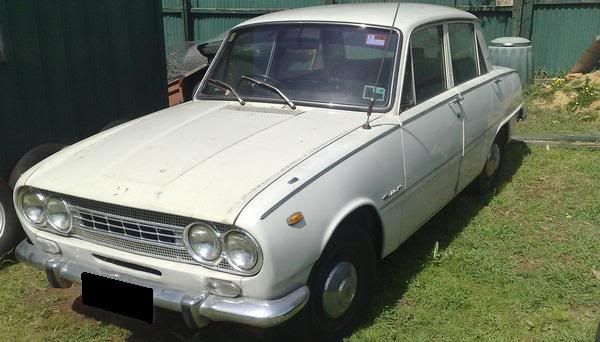
 so i have a little bit of surface rust there. no rust in seal panels, so i'm really lucky. only rust is in that little grill above the bonnet do you know where i am talking about?